-1.webp)

Part 5 of our build-in-the-open series. The last one answered whether you can trust an AI team with your data. This one answers the question that comes right after: what does the thing actually cost to run? Not to build. To run, day after day, once it is live.
Fifty-nine cents.
That was the number in our #ops channel one morning: the whole AI team's model time for the previous day. Every morning report it wrote, every meeting it prepped, every research pull, every question it answered, all of it, totalled up and posted before I sat down. Less than the coffee I was holding while I read it.
I did not take the number on faith. I know it is fifty-nine cents and not fifty-eight, and I can tell you which agent spent what, because the system counts every call it makes down to a millionth of a dollar. That habit is the whole subject of this post. Most conversations about what AI costs are guesses wearing a suit. This one is arithmetic you can check.
The question right after "can I trust it"
Last time I wrote about the question every owner asks before anything else: can you trust it with your data. The one that comes right after is about money, and it is usually asked with a wince, because the honest expectation is that the answer is either "we do not really know" or "more than you think."
Both of those answers are common, and both come from the same place. Search "what does an AI agent cost" and you will drown in pieces about what it costs to build one, five-figure quotes for a custom bot, monthly retainers, setup fees. Almost nobody tells you what a single thing the agent does actually costs once it is running, because most people selling agents genuinely do not meter it at that level. They price the project, not the task.
We went the other way. Every action the team takes is priced the moment it happens, logged with the tokens it used and the exact fraction of a dollar it cost. So when someone asks what this costs to run, I do not reach for a range. I reach for the receipts.
We know what every call costs, to the microdollar
Here is the mechanic, in plain terms. Every model has a fixed price per word it reads and per word it writes. The model we use for real work, Anthropic's Sonnet, costs three dollars for a million words in and fifteen for a million out. The cheaper model we use for quick decisions, Haiku, is a third of that on the way in and a third on the way out. Those prices are not our estimate. They are the published rate card, and they sit in the code as a small table the system reads on every call.
When an agent finishes a task, we already know exactly how many words went in and came back, because the model tells us. Multiply those two numbers by the rate, and you have the cost of that one action, to the microdollar. A microdollar is a millionth of a dollar, and we count in them on purpose, because the individual actions are genuinely that cheap and rounding to cents too early would throw the total off.
That number does not evaporate. It gets written to a row in our database alongside the tokens, the model, which agent ran, how long it took, and whether it worked. One task, one receipt. Nothing is estimated after the fact, because nothing needs to be.
What one task actually costs
So what does a receipt actually say? Take the token prices, multiply by what a real task uses, and the numbers come out like this.
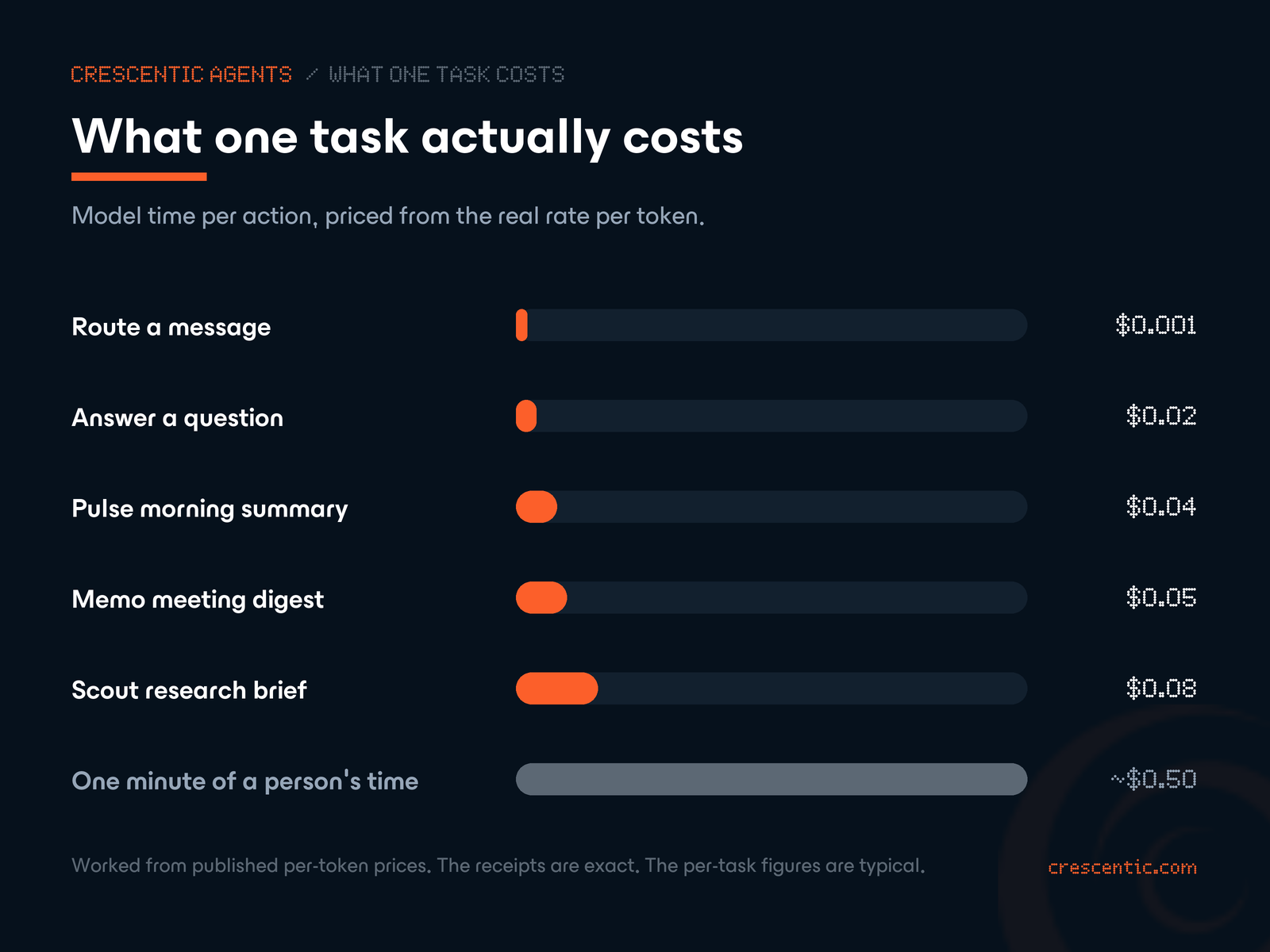
A morning summary of a project, the kind of thing Pulse posts before anyone logs on, reads a few thousand words of activity and writes a short digest. Call it four cents. A research brief from Scout does more, it reads web results and prior notes and pulls it all together, so it runs closer to eight. Memo turning an hour-long transcript into a clean record of decisions lands around five. And the little decision at the front of every conversation, working out which agent should even answer, costs about a tenth of a cent.
I want to be plain that these are worked estimates, not a bill I photographed. The prices are real and public, the token counts are typical for each task, and I have put the math right on the chart so you can argue with it. That is the point. A cost you can reproduce is worth more than a total you have to trust.
A cheap brain for cheap decisions, a smart brain for the work
That tenth-of-a-cent routing step is not an accident, it is where a lot of the savings live.
Every message that comes in gets a quick first pass from the cheap model, whose only job is to decide who should handle it, Pulse or Scout or Memo, or whether it needs a human. Only after that does the expensive model wake up to do the actual work. The cheap brain triages, the smart brain answers.
You can see the split in the ledger, because every interaction leaves two receipts, not one: a near-free routing run, then the real one. It would be simpler to send everything to the powerful model and skip the sorting. It would also cost more on every single message, for no benefit, because you do not need a frontier model to notice that "what's on my calendar" is a Scout question. Matching the tool to the size of the job is most of cost control, in AI as in anything else.
The cost report that costs nothing to run
All of this would be academic if nobody looked at it, so once a day the system totals up the previous twenty-four hours and posts it to #ops, broken out by agent, with the grand total at the bottom. That fifty-nine-cent morning was one of these.
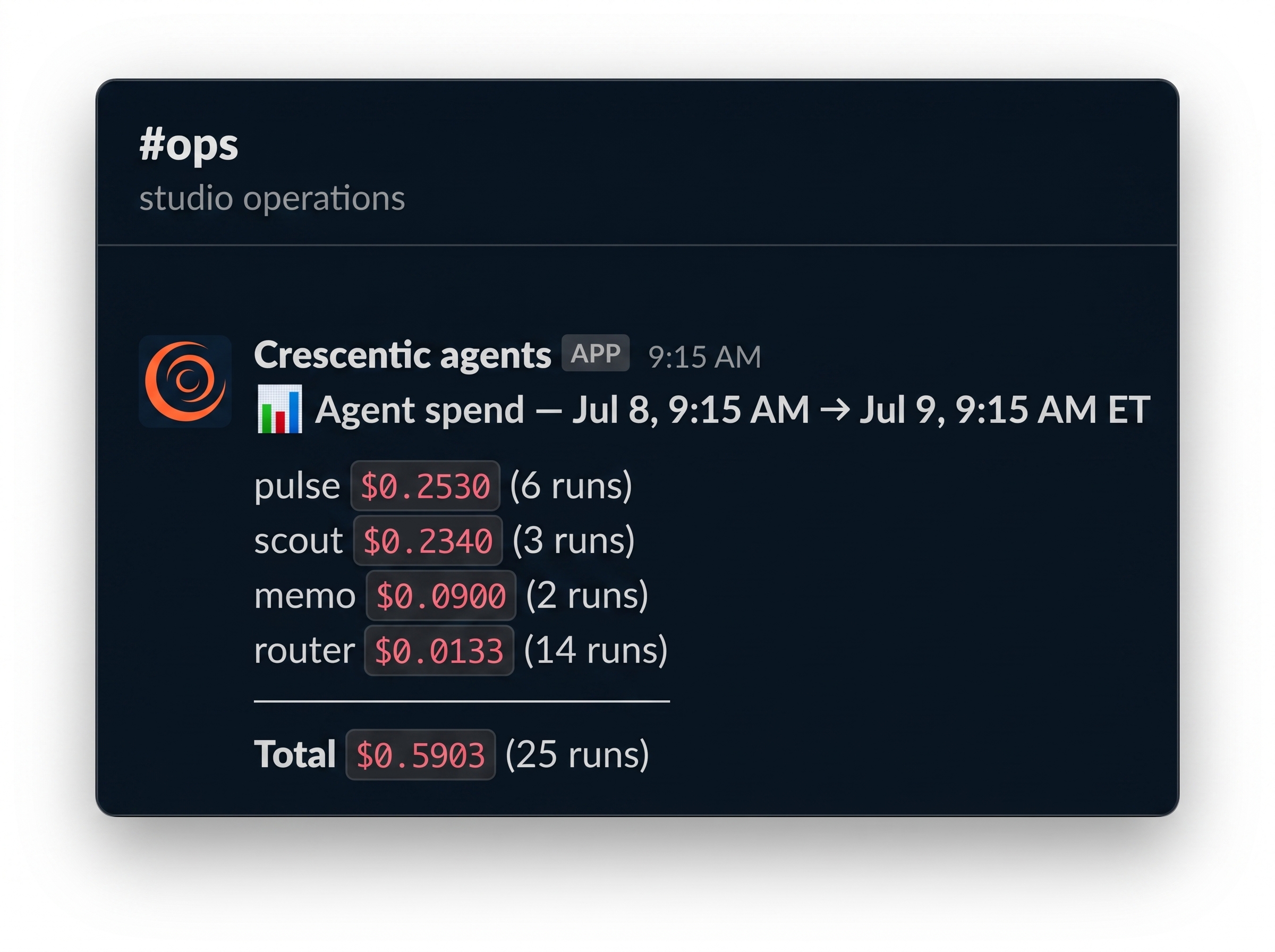
The quiet joke in that report is that it costs nothing to produce. Building it does not involve asking a model anything, it is just a database query and some formatting, so the part of the system whose entire job is watching the spend adds nothing to the spend. The thing that keeps us honest about cost is itself free.
That is the difference between metering and guessing. I am not inferring what a week cost from a monthly invoice. I am reading what yesterday cost from a report the system wrote itself, for free, agent by agent.
What the meter leaves out
Now the part a build log owes you, because a number this small is easy to wave around dishonestly.
Everything above is the cost of the model thinking. It is not the total cost of running this. There is the plumbing the whole thing sits on, our database and the platform it runs on, which bill on their own small schedule. There was the time it took to build, which was real and is not free just because it is already paid. And there is a person, me, still keeping an eye on it, which is the cost people quietly leave out most often. When someone hands you a single tidy "the AI costs this much" figure, one of those three is usually missing.
So the honest framing is narrow on purpose. Four cents is what the model charges to write a morning report. It is not what it costs to own an AI team. Even multiplied out across a busy month the model's meter stays in the low tens of dollars, which is genuinely the surprising part, but that meter is a line on the bill, not the whole bill. I would rather you hold me to the narrow claim I can prove than trust a round one I cannot.
The estimates lean on assumptions too. A task that reads a much bigger document costs more than the typical figure on that chart, and a model we have not priced yet gets logged at zero until we add its rate, which the system flags rather than hides. The receipts are exact. The forecasts built on them are still forecasts.
The same sum, in any business
Strip the word "studio" off all of this and it is just the question any owner asks about any tool: does what it does cost less than what it saves. The reason cost-per-task matters is that it is the only honest input to that sum.
The one outside number worth borrowing here comes from IDC, in research Microsoft sponsored across roughly four thousand businesses: generative AI is returning about $3.70 for every dollar spent. I am citing that as their number, not ours, and any single ROI figure deserves a raised eyebrow. But the shape holds, and it only holds if you actually know the per-task cost, which is the number almost nobody publishes.
A clinic weighing an AI that drafts visit summaries does not need a vendor's monthly quote, it needs to know a summary costs a few cents so it can set that against the nurse-hours it saves. A law firm can decide whether an AI that digests depositions earns its place the moment it knows a digest costs a nickel, not a mystery. A finance team, audited on every figure, will trust a system that meters its own spend to the microdollar long before it trusts one that cannot. The cost per task is what turns "is this worth it" from a vibe into a calculation.
What is next
That is the whole series, told one teammate and one hard question at a time: what it does, whether you can trust it, and what it costs to run. The last post pulls back to the shape of the thing itself, one small system, quietly running a whole studio, and why we built it ourselves instead of buying a platform.
If you have read this far and your first instinct is to check my arithmetic, good. That is exactly the instinct a cost number should provoke. The point was never to impress you with how cheap it is. It was to show you the meter, and let you do your own sum.
We're building this in the open. Follow along for the last one in the series, and if you're already running the numbers for your own shop, say hi.
Technical readers: the microdollar accounting, how token usage becomes a logged cost, the two-row router/worker split, the LLM-free daily report, and the exact queries we run to pull real spend, it's all in the appendix.